

Social media channels play a central role in inbound marketing when viewed as a strategic partnership rather than an isolated tactic. Platforms such as Instagram, LinkedIn, and TikTok act as dynamic ecosystems that attract attention, nurture interest, and strengthen relationships across every stage of the buyer’s journey. Their ability to combine visibility, interaction, and personalization turns each touchpoint into an opportunity to build trust and guide decisions. This article examines that synergy, breaking down exactly how social media channels contribute to inbound marketing and revealing why they have become an essential pillar of any effective strategy.
Understanding Inbound Marketing and Its Core Philosophy
Inbound marketing is a customer centered approach that draws people toward a brand through valuable content instead of interrupting them with unsolicited ads. Rather than buying attention through cold calls or purchased email lists, the methodology focuses on creating educational material that naturally pulls prospects toward a website, where they can explore products or services at their own pace. HubSpot, the organization that popularized the term, breaks the framework into three connected phases, attract, engage, and delight, each designed to guide a stranger through progressive stages until they become a loyal advocate.
What makes this philosophy distinct is its respect for the buyer’s autonomy. Traditional advertising pushes messages onto passive audiences, while inbound marketing earns permission by aligning content with what people are already searching for or discussing online. This subtle shift in posture is precisely why social platforms fit so naturally into the equation, since they are built on voluntary engagement rather than forced exposure.
Why the Attract Stage Depends on Social Visibility
Attracting the right audience requires more than publishing content and waiting for discovery. Search engines reward relevance, but social platforms amplify reach in ways that organic search alone cannot replicate, especially for time sensitive topics or visual storytelling. A well crafted blog post gains little traction if nobody sees it, so distributing that same content across Instagram Reels, LinkedIn posts, or Pinterest boards multiplies its chances of being found by someone who was not actively searching yet.

This is where social media becomes a discovery layer for inbound strategies. Algorithms on these platforms surface content based on interest signals, meaning a well targeted post can reach potential customers who never typed a related query into Google. That kind of exposure complements SEO rather than competing with it, filling gaps that keyword based search cannot always reach.
How Social Media Channels Contribute to Inbound Marketing at Every Funnel Stage
Each stage of the inbound funnel benefits from a distinct social media function, and understanding these roles clarifies why the channel deserves a dedicated place in any content calendar. During the attract phase, platforms act as amplifiers, pushing blog posts, videos, and infographics toward audiences who match a brand’s ideal customer profile. Once someone follows or engages with an account, the convert phase kicks in, where compelling captions, link stickers, and bio links direct that curiosity toward landing pages or lead magnets.
The close phase often gets overlooked in social conversations, yet platforms like LinkedIn and Facebook increasingly support direct messaging, shoppable posts, and integrated forms that shorten the path between interest and purchase. Finally, the delight phase relies heavily on community management, where responding to comments, sharing user generated content, and hosting live sessions transforms satisfied customers into vocal promoters. A study on B2B demand generation found that ninety one percent of consumers visit a brand’s website after following and engaging with that brand on social media, which illustrates how strongly these interactions influence eventual conversions.
Building Trust Through Consistent Engagement
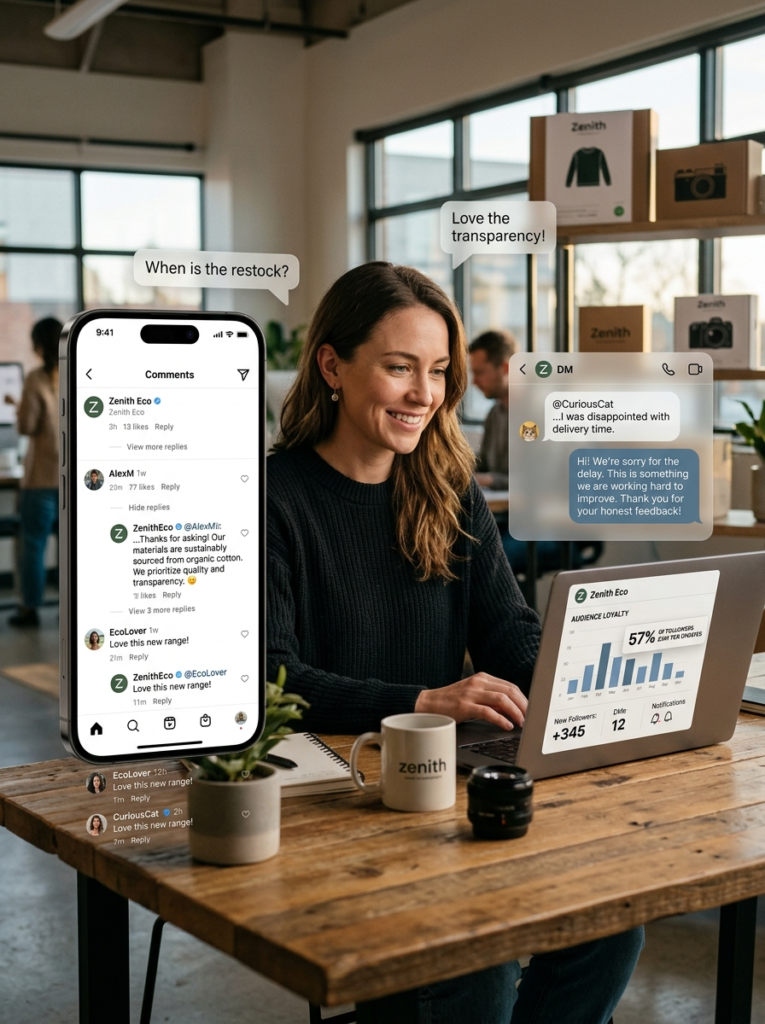
Trust rarely forms after a single interaction. It accumulates gradually as an audience watches a brand answer questions, share behind the scenes moments, and respond honestly to criticism. Social platforms give marketers a stage to demonstrate this consistency in ways that static websites cannot, since comments and direct messages create a visible record of how a company treats its community.
Fifty seven percent of consumers report following companies specifically to stay updated on products and services, which suggests that many people view social channels as an ongoing relationship rather than a one time transaction. That expectation places pressure on brands to maintain a steady publishing rhythm, but it also rewards those who show up authentically over time.
Content Formats That Strengthen the Connection
Different social formats serve different inbound purposes, and recognizing these distinctions helps marketers avoid a scattershot approach. Short form video, for instance, excels at capturing attention within seconds, making it ideal for the attract stage where curiosity needs to be sparked quickly. Longer form content such as LinkedIn articles or YouTube tutorials tends to perform better during the engage stage, since audiences who reach that depth of content usually already have some familiarity with the brand.
Carousel posts and infographics occupy a middle ground, breaking down complex ideas into digestible visual steps without demanding as much time investment as video. Meanwhile, live streams and Stories create a sense of immediacy that static posts cannot match, often driving the kind of spontaneous engagement that algorithms favor. Choosing the right format for each stage prevents wasted effort and ensures that content aligns with what the audience is actually ready to consume.
The Role of User Generated Content and Social Proof
Nothing builds credibility quite like seeing real customers vouch for a product, and social platforms are uniquely suited to surfacing that kind of proof. Reviews, testimonials, and unboxing videos shared by actual users carry a weight that branded messaging simply cannot replicate, since audiences instinctively trust peer recommendations over corporate claims.
Encouraging this behavior does not require elaborate campaigns. Simple tactics like branded hashtags, customer spotlight features, or reposting tagged content can turn everyday buyers into informal ambassadors. When woven into an inbound strategy, this kind of social proof shortens the trust building process considerably, since prospects arrive at a landing page already convinced by someone else’s experience rather than needing to be persuaded from scratch.
Measuring the Real Impact on Lead Generation
Skeptics sometimes question whether social media truly drives measurable business results, but the data increasingly supports its role in demand generation. Fifty one percent of B2B marketers reported that social media contributed directly to lead generation and sales growth in a recent survey, a dramatic increase from just six percent only two years earlier. That trajectory suggests the channel is maturing from a brand awareness tool into a genuine revenue driver.
LinkedIn in particular has become the dominant platform for B2B content, with ninety six percent of marketers using it for publishing and the majority also investing in paid promotion there. This concentration makes sense given the platform’s professional context, where decision makers are more likely to engage with industry insights than they would on more casual networks. For consumer facing brands, Instagram and TikTok tend to occupy that same central role, though the underlying principle remains identical, meeting the audience where they already spend their time.
Connecting Analytics Back to Inbound Goals
Tracking likes and shares alone tells an incomplete story, since vanity metrics rarely correlate directly with revenue. A more useful approach ties social engagement to specific funnel stages, measuring click through rates to landing pages, form completions originating from social traffic, and eventual customer conversion rates attributable to social referrals. Eighty percent of marketers using social media already track some form of metric, which shows the industry has largely moved past treating these platforms as purely qualitative tools.
That said, interpreting the data requires context. A spike in followers means little if those followers never engage with subsequent content or click through to owned properties. Marketers who succeed at this measurement challenge typically integrate their social analytics tools with broader platforms like Google Analytics or HubSpot, allowing them to trace a single lead’s journey from an initial Instagram comment all the way to a closed sale.
Practical Strategies for Integrating Social Media Into Inbound Campaigns
Building an effective bridge between social platforms and inbound goals starts with clear objectives for each channel rather than a one size fits all posting schedule. A few foundational practices consistently separate successful integrations from scattered efforts:
- Align every social post with a specific funnel stage, whether that means sparking awareness or nudging an engaged follower toward a landing page.
- Repurpose long form blog content into shorter social friendly formats to extend its reach without duplicating effort.
- Use platform native features like link stickers, shoppable tags, and lead forms to reduce friction between interest and action.
- Monitor comments and direct messages as genuine feedback channels rather than just customer service overhead.
These practices work best when treated as an ongoing rhythm rather than a checklist to complete once. Consistency matters more than perfection, since algorithms and audiences alike tend to reward accounts that show up reliably over months rather than sporadically.
Avoiding Common Pitfalls
Many brands stumble by treating social media as a broadcast channel rather than a conversational one, pushing promotional content without leaving room for dialogue. This approach tends to suppress reach on most modern platforms, since algorithms increasingly favor content that generates genuine interaction over passive impressions. Another frequent mistake, involves neglecting the handoff between social engagement and the website experience, where a beautifully crafted post leads to a slow loading landing page that undoes all the goodwill built beforehand.
Inconsistent branding across platforms can also dilute trust, particularly when a company’s voice on LinkedIn feels disconnected from its tone on Instagram. Buyers notice these inconsistencies, even if only subconsciously, and that friction can quietly erode the confidence an inbound strategy works so hard to build.
Looking Ahead at the Evolving Relationship
The connection between social platforms and inbound methodology continues to deepen as features blur the line between content discovery and direct purchasing. Shoppable posts, in app checkout, and AI powered content recommendations are compressing the distance between attraction and conversion, sometimes collapsing several funnel stages into a single scroll. Marketers who adapt to this compression, rather than clinging to older linear models, will likely capture disproportionate value as these tools mature.
At the same time, the fundamental logic behind inbound marketing remains unchanged. Audiences still respond to genuine value, consistent presence, and content that respects their time and intelligence. Social media simply gives that philosophy a faster, more visible stage on which to perform, connecting brands with the right people at precisely the moment curiosity turns into intent.
FAQ about Social Media and Inbound Marketing
Discover how to integrate social media as a core pillar in your Inbound Marketing strategy to attract, engage, and delight your customers.
If you want to bring this strategy to your brand, schedule a consulting session with Digistic.
Schedule a consultation